How to Revise for an Exam Overnight: A Realistic, No-Panic Plan
September 2, 2026
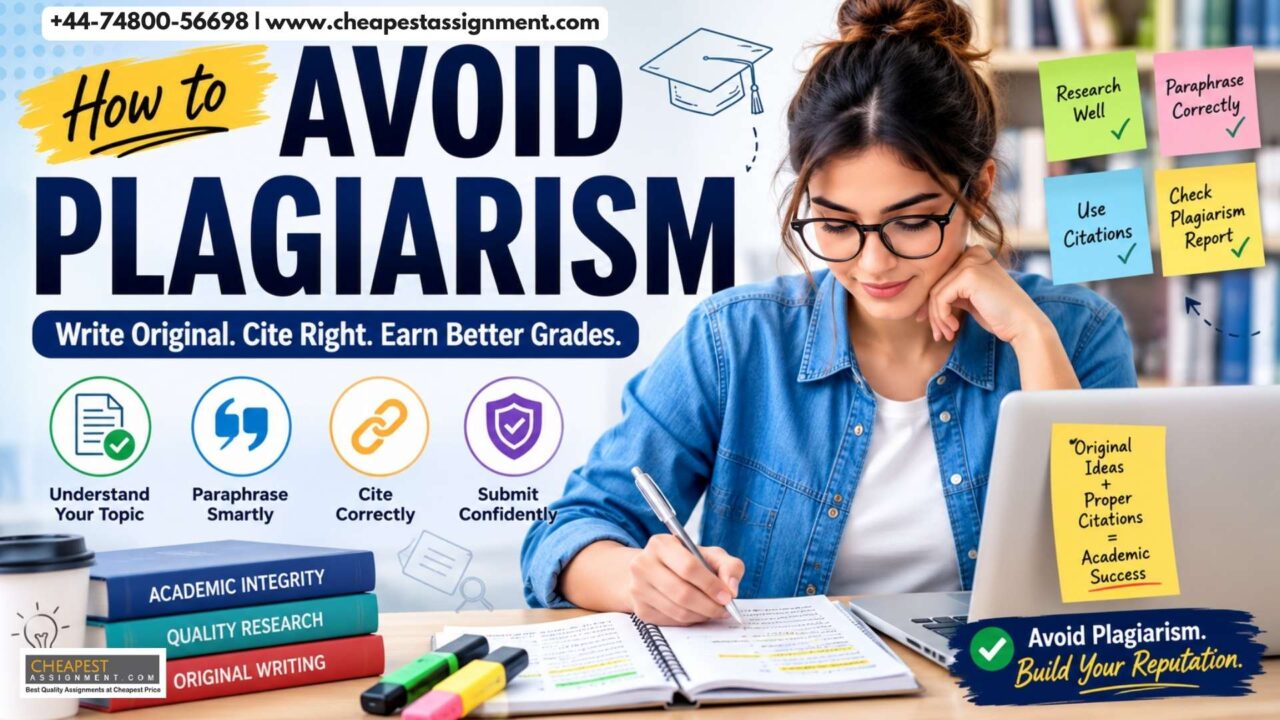
Students often ask how to avoid plagiarism only when a deadline is close or a similarity report looks worrying. The safer approach begins much earlier. Original academic writing depends on organised research, accurate note-taking, genuine understanding, proper citation and a final review of every borrowed idea. Once those habits become part of your writing process, plagiarism is easier to prevent and your arguments usually become stronger as well.
Plagiarism is not limited to copying a full paragraph from a website. It can include an uncited paraphrase, a reused assignment, an unattributed image, copied code, invented references or AI-generated material submitted against course rules. Some cases are deliberate, but accidental plagiarism is also common when students lose track of sources, misunderstand citation styles or rush their work.
This guide explains what is plagiarism, the main types of plagiarism, why it happens and how to prevent plagiarism at every stage of an assignment. It also covers paraphrasing, citations, Turnitin similarity scores, online classes and responsible use of AI writing tools. If you need academic support, the final section explains how to use guidance ethically without giving up ownership of your work.
Key Takeaways
- Plagiarism means presenting another person’s words, ideas, data, images or other work without appropriate credit.
- Changing a few words does not make borrowed material original; a genuine paraphrase still needs a citation.
- A similarity score identifies matching text. It does not decide whether plagiarism occurred.
- The most reliable way to avoid plagiarism in assignments is to record sources and cite them during research and drafting, not after the paper is finished.
- Rules for AI writing tools differ among institutions, courses and assessments. Check the exact policy before using any tool.
- Ethical academic help should improve your understanding, planning, research and writing. It should never replace your authorship.
What Is Plagiarism?
The simplest plagiarism definition is the presentation of someone else’s words, ideas or creative work as if they were your own. The missing element is acknowledgement. If a reader could reasonably believe that borrowed material originated with you because the source is not identified, the work may be plagiarised.
Plagiarism can involve more than written sentences. Academic work may require credit for theories, arguments, research findings, statistics, tables, diagrams, photographs, videos, computer code, translations and distinctive organisational structures. Even when content is publicly available online, access does not remove the obligation to acknowledge its creator.
Plagiarism may be intentional or accidental. A student who buys a complete paper and submits it is acting deliberately. A student who paraphrases a journal article but forgets the citation may not intend to deceive, yet the submitted text still fails to show where the idea came from. Institutions may consider intention when deciding a penalty, but students should not assume that a mistake is automatically harmless.
Plagiarism in Plain English
Ask two questions whenever you add material to an assignment:
- Did these exact words come from someone else?
- Did this idea, fact, image, data set or method come from a specific source?
If the answer to either question is yes, acknowledge the source in the form required by your course. Exact words normally need quotation marks or block-quote formatting in addition to a citation. Borrowed ideas need a citation even when you explain them entirely in your own words.
For example, imagine that an article reports a connection between sleep quality and memory performance. Replacing “connection” with “relationship” while retaining the original sentence structure is not a proper paraphrase. A better approach is to understand the finding, set the source aside, explain the relevant point in a new structure, connect it to your argument and cite the article.
ChatGPT, Claude or DeepSeek? A Student’s Guide to Using AI for Assignments
Plagiarism and Academic Integrity
Academic integrity is broader than plagiarism. It is the commitment to honest, responsible and transparent learning. Plagiarism is one way to violate that commitment, alongside cheating in an examination, fabricating evidence, unauthorised collaboration, contract cheating or misrepresenting the use of AI.
Academic integrity matters because assessment is intended to show what a student understands and can do. Accurate acknowledgement also lets readers examine the evidence behind an argument and gives creators appropriate credit. These habits extend beyond university: employers, researchers and professional bodies expect people to distinguish their own contributions from the work of others.
Consequences vary by institution, level of study, intention and previous history. They may include a request to revise, a reduced mark, a zero for the assessment, failure of a module or formal disciplinary action. Instead of guessing, read the academic integrity policy and the assessment instructions that apply to your course.
What Are the Different Types of Plagiarism?
Understanding the types of plagiarism makes prevention easier. The labels used by universities are not always identical, but the following categories describe the most common problems in academic writing.
Direct Plagiarism
Direct plagiarism occurs when exact wording is copied without quotation marks and proper attribution. It may involve one distinctive sentence or several paragraphs. Copying material and adding the source only to the reference list is not enough, because readers still cannot see which words are quoted.
To use exact wording correctly, reproduce it accurately, mark it as a quotation, add the required in-text citation and include the complete reference. Use quotations selectively. A paper built from long quotations may be cited correctly but still show too little analysis from the student.
Global Plagiarism
Global plagiarism means presenting an entire work, or nearly all of it, as your own when someone or something else produced it. Examples include submitting another student’s paper, downloading a completed essay, using a purchased answer as a final submission or asking another person to complete the assessment.
This is generally treated as a serious and deliberate form of academic misconduct. It cannot be repaired by adding a few citations, because the central misrepresentation concerns authorship of the whole work. If time, language difficulties or personal circumstances make an assignment feel impossible, contact the lecturer or student-support service before the deadline.
Accidental Plagiarism
Accidental plagiarism can result from incomplete notes, missing quotation marks, a forgotten reference, incorrect paraphrasing or uncertainty about what requires a citation. It is especially likely when source material and a student’s own comments are mixed in the same document without labels.
Good intentions are not a substitute for a reliable process. Keep a source log, identify copied words clearly in your notes, capture page numbers and add citations during the first draft. These small actions are more dependable than trying to reconstruct sources on the final night.
Mosaic Plagiarism
Mosaic plagiarism, sometimes called patchwriting, happens when phrases or sentence patterns from one or more sources are woven into new text without clear quotation or sufficient rewriting. The result may contain original connecting words, but the language and structure remain too close to the sources.
Patchwriting often occurs when a student writes while looking directly at the original. Prevent it by taking concept-based notes, closing the source and drafting from your understanding. Then compare the draft with the original for accuracy and excessive similarity before adding the citation.
Self-Plagiarism
Self-plagiarism is the undisclosed reuse of your own previously submitted or published work. Students sometimes assume that because they wrote the material, they can submit it again. However, a new assessment normally requires new work, and the same text may not be used for credit twice without permission.
If an earlier project is relevant, ask the instructor what reuse is allowed. You may be able to cite the earlier work, develop the topic from a new angle or use limited background material with disclosure. Written permission protects both you and the integrity of the new assessment.
Source-Based Plagiarism
Source-based plagiarism includes misleading or fabricated citations. A writer might cite a source that does not support the claim, reference a paper that was never read, invent publication details or cite a secondary discussion as though the original study had been consulted.
Check every reference against the actual source. If you encounter an idea quoted inside another publication and cannot access the original, follow the required rule for secondary citations rather than pretending to have read it. Never include references simply to make a bibliography look longer.
Image, Data and Code Plagiarism
Visual and technical material also requires attribution. Reusing a chart, photograph, data set, design, formula, laboratory method or code fragment may require a citation, a licence acknowledgement or permission. Open-source code is available under stated licence conditions; it is not automatically free of attribution requirements.
Record the creator, title, date, repository or website, licence and stable link when you find the material. For code assignments, also check whether collaboration, libraries, code-generation tools or online examples are permitted. Course rules can be stricter than a resource’s licence.
What Are the Main Causes of Plagiarism?
The causes of plagiarism usually involve process problems, pressure or misunderstandings rather than a single moral failure. Identifying the cause helps a student choose a practical solution.
Poor Time Management
When research begins too late, students may copy passages into the draft because they do not have time to understand or synthesise them. They may also omit citations while trying to reach the word count quickly.
Divide the assignment into research, planning, drafting, citation and revision stages. Set a personal deadline at least a day or two before the official deadline where possible. A modest early start gives you time to ask questions, replace weak sources and correct accidental plagiarism.
Unclear Citation Knowledge
Citation styles contain many details, and new students may be unsure about paraphrases, page numbers, online sources or reference-list formatting. Confusion becomes risky when it leads to no citation at all.
Use the guide recommended by your institution and check examples for the exact source type. Learn the core principle first: readers must be able to see what came from elsewhere and locate that source. Formatting tools can help, but their output still needs to be checked.
How to Revise for an Exam Overnight: A Realistic, No-Panic Plan
Weak Note-Taking
Notes copied from a source can later look like the student’s own writing, particularly when quotation marks and source details are missing. This creates accidental plagiarism during drafting.
Separate direct quotations, paraphrases and personal observations visually. One simple system is to label them Q, P and M for quotation, paraphrase and my idea. Add the source and page number beside every Q and P entry. Never keep an unattributed sentence in research notes.
Pressure to Achieve High Marks
Competition, scholarship requirements, workload and fear of disappointing others can make shortcuts seem attractive. Yet a poor result on one honest attempt is usually easier to recover from than an academic misconduct finding.
Ask for support early. A lecturer may clarify the task, a writing centre may review structure, and student services may help with exceptional circumstances. Seeking legitimate assistance is a responsible academic decision, not a failure.
Language and Confidence Difficulties
Students writing in an additional language may stay too close to a source because they are afraid that their own wording will sound less sophisticated. This can lead to patchwriting.
Aim for clear, accurate language rather than imitating the source’s vocabulary. Build a short glossary of subject terms, practise summarising one paragraph at a time and use feedback to improve. Editing support should preserve your meaning and voice rather than replacing them.
Misunderstanding Collaboration
Group discussion may be allowed while shared answers are prohibited. Friends can unintentionally produce very similar work after planning together or exchanging drafts.
Check where collaboration ends and individual authorship begins. Unless the task is explicitly shared, create your own outline, analysis and final wording. Do not send editable final answers to classmates or reuse a group’s sentences in an individual submission.
Easy Access to AI and Online Content
Search engines, file-sharing sites and AI tools can provide instant text, which may blur the difference between assistance and authorship. Convenience does not determine whether use is allowed.
Read the assessment-specific rules. Some instructors allow AI for brainstorming but require disclosure; others prohibit it for the entire task. Keep prompts, outputs, notes and drafts if your institution asks for a record of the writing process. Verify all facts and references independently.
How to Avoid Plagiarism in Your Assignments Step by Step
Knowing how to avoid plagiarism is mainly about designing a traceable writing process. The following method works for essays, reports, literature reviews, case studies and many online assessments.
Step 1 Read the Assignment and Integrity Rules
Before researching, identify the task, permitted resources, required citation style, collaboration rules and AI policy. Highlight verbs such as analyse, compare, evaluate or recommend because they show what original thinking the assignment expects.
If any instruction is unclear, ask. Do not assume that a tool allowed in one module is allowed in another. Save a copy of the brief so you can check compliance before submission.
Step 2 Choose a Focused Question or Argument
A clear position makes the paper less dependent on source wording. Decide what question you are answering and what your provisional response will be. Your argument can change as you research, but an initial direction helps you select evidence rather than collect random paragraphs.
Turn the topic into smaller research questions. For example: What is the central claim? What evidence supports it? What evidence challenges it? What concept or case will I use? These questions encourage synthesis and analysis.
Step 3 Build a Source Log
Create a table or reference-manager entry for each source. Record the author, date, title, publisher or journal, DOI or URL, access date where required, useful page numbers and a brief note about relevance.
Save this information immediately. Websites change, tabs close and downloaded files may have unclear names. A source log prevents the stressful search for a missing reference after the draft is complete.
Step 4 Take Notes in Your Own Words
Read a section until you understand it, then look away and write the key point briefly. Compare your note with the source to check accuracy. If a phrase must be preserved exactly, use quotation marks in the notes and record its page number.
Add your reaction beside the source note: why it matters, how it relates to another author or where it might fit in your argument. This separates evidence from analysis and makes the eventual draft more original.
Step 5 Create an Outline Before Drafting
Organise the argument into sections and assign evidence to each one. Every paragraph should have a purpose: make a claim, provide evidence, interpret it and connect it to the overall argument.
An outline prevents a common problem in academic writing: following the order of one source so closely that the paper becomes a disguised summary. Arrange ideas according to your question, not according to the sequence in which you found them.
Step 6 Draft From Notes Rather Than Sources
Keep your source log and concise notes nearby, but avoid composing line by line while staring at the original passage. Draft the explanation in your natural academic voice. Insert a temporary citation immediately whenever a sentence relies on a source.
Placeholders such as “CITATION NEEDED” are useful only if you resolve every one. Search for them during revision. Do not leave citation work until the end, when the origin of ideas is harder to remember.
Step 7 Use Quotations Carefully
Quote when the exact wording is important, when you are analysing language or when a concise authoritative definition is necessary. Introduce the quotation, provide the correct citation and explain its relevance afterward.
Avoid dropping quotations into a paragraph without context. A quotation should support your reasoning, not perform the reasoning for you. Long quotations also increase similarity, even when properly cited, and may reduce the space available for analysis.
Step 8 Paraphrase Properly
Paraphrasing to avoid plagiarism requires more than replacing words with synonyms. Change the sentence structure and emphasis because you genuinely understand the idea, while preserving its meaning. Then cite the source.
A reliable process is:
- Read the relevant passage twice.
- Identify its essential meaning.
- Close or cover the source.
- Explain the point in a new structure and in language natural to you.
- Compare both versions for accuracy and borrowed phrasing.
- Add the in-text citation.
- Explain how the point supports your own argument.
Step 9 Cite as You Write
Proper citation works best in real time. Add an in-text citation as soon as you use a quotation, paraphrase, statistic, model, image or specific finding. Add or confirm the full reference at the same time.
At the final review, match every in-text citation to one reference-list entry and every reference-list entry to material actually cited in the paper. Remove duplicates, correct names and dates, and check links or DOIs.
Step 10 Review With a Plagiarism Checker
A plagiarism checker can reveal text that matches material in its database. Review each match rather than chasing an arbitrary number. References, assignment titles, common phrases and correctly quoted text may produce legitimate matches. Unquoted wording or a close paraphrase may require revision even if the overall score is low.
Use only a checker approved by your institution or a service with clear privacy terms. Uploading an unpublished assignment to an unknown website may expose personal information or store the paper in a database.
Step 11 Keep Evidence of Your Writing Process
Save your outline, notes, source log, early drafts and feedback. Version history can help you track your own development and correct mistakes. It may also show how the work was produced if questions arise about authorship or AI use.
Name files clearly and back them up. A simple folder containing the brief, sources, notes, drafts and final submission is enough for most assignments.
What Needs a Citation and What Usually Does Not?
One of the easiest ways to avoid plagiarism in assignments is to know what acknowledgement is expected.
Cite These Materials
- Exact words from a source
- Paraphrased or summarised ideas
- Statistics and research findings
- A theory, model or method associated with a creator
- Images, tables, charts, maps and diagrams you did not create
- Code, data sets and material from repositories
- Translated ideas or passages from another source
- AI output when institutional rules require citation or disclosure
- Personal communication when the citation style permits it and consent requirements are met
These Usually Do Not Need a Citation
- Your own analysis, conclusion or original example
- Your personal experience when the assessment permits it
- Data you collected yourself, described according to the course’s research rules
- Widely accepted common knowledge
Common knowledge depends on audience and discipline. “Water freezes at 0°C under standard atmospheric pressure” is commonly known, whereas a precise statistic about water consumption needs a source. When uncertain, ask the instructor or cite the reliable source supporting the claim.
Quoting, Paraphrasing and Summarising Without Plagiarism
Quoting, paraphrasing and summarising are three legitimate ways to integrate evidence. The right choice depends on your purpose.
When to Quote
A quotation reproduces the original language exactly. Use it when wording itself matters, when analysing a definition or when a short statement would lose force or precision if rewritten. Quotation marks, an in-text citation and often a page or paragraph locator are required.
Check every character against the source. Indicate omissions or changes using the convention required by your citation style. Do not alter wording in a way that changes the author’s meaning.
When to Paraphrase
A paraphrase restates a specific idea in a genuinely new form and usually at a similar level of detail. It lets your paper maintain a consistent voice while still crediting evidence.
The citation remains necessary because ownership of the idea has not changed. APA Style and Purdue OWL both emphasise that paraphrased material must be attributed to the original source. A paraphrase is therefore not a method for removing citations; it is a method for integrating understanding.
When to Summarise
A summary condenses the main point of a longer passage, article or group of sources. It is useful when readers need the overall conclusion rather than every supporting detail.
Summaries also require attribution. When combining several sources, make it clear which claims belong to which authors. Avoid attaching one citation to a long paragraph when readers cannot tell what it covers.
A Practical Paraphrasing Test
Compare your version with the source and ask:
- Is the structure substantially different?
- Have I expressed the meaning in language natural to me?
- Is the meaning still accurate?
- Have I avoided distinctive phrases unless they are quoted?
- Is the source cited where the borrowed idea appears?
- Have I added analysis rather than merely replacing vocabulary?
If the answer to any question is no, revise before submission.
Citation Styles Used in Academic Writing
Citation styles organise the same basic information in different ways. Always use the style named in the assignment brief rather than selecting one at random.
APA Style
APA commonly uses author-date in-text citations and is widely associated with psychology, education, nursing and social sciences. A paraphrase typically identifies the author and year; direct quotations also use an appropriate locator such as a page number where available.
MLA Style
MLA commonly uses author-page citations and is often used in literature, languages and humanities. The Works Cited list supplies the full publication information.
Chicago Style
Chicago offers notes-and-bibliography and author-date systems. History and some humanities subjects often use footnotes or endnotes, while other disciplines may use author-date citations.
Harvard Referencing
Harvard is an author-date approach with variations among institutions. Follow your university’s guide because punctuation, capitalisation and treatment of online sources may differ.
Reference Managers and Citation Generators
Reference managers can store sources and create citations efficiently, but they do not guarantee accuracy. Imported metadata may contain a missing author, incorrect capitalisation or the wrong item type. Compare generated references with the official style guide and the original publication.
How to Synthesize Sources Without Plagiarising
Synthesis is more than placing several summaries next to one another. It means identifying a relationship among sources and using that relationship to develop your own answer. Good synthesis helps readers see agreement, disagreement, change over time, differences in method or gaps in existing knowledge.
Begin with a question or theme rather than an author. If three researchers discuss student motivation, do not automatically write one paragraph about each researcher. Instead, group their evidence according to the aspect of motivation it explains. A paragraph might compare how the studies define motivation, another might examine differences in their participants, and a third might evaluate which explanation best fits your assignment question.
Use a Synthesis Matrix
A synthesis matrix is a simple planning table. List your themes across the top and your sources down the side. In each cell, record the relevant finding, method, limitation or quotation with its page number. Empty cells quickly reveal which sources do not address a theme and where further research may be needed.
The matrix also reduces source-by-source writing. When you draft a paragraph, you can compare evidence from the relevant column rather than following one article’s structure. Cite each source at the point where its contribution appears.
Keep Your Voice in Control
Start a paragraph with the claim you want to establish, not with an author’s name unless the author is the focus. Then introduce evidence, compare it and explain its significance. Useful questions include:
- Do the sources reach the same conclusion for different reasons?
- Are their methods or samples comparable?
- Does newer evidence confirm or challenge earlier work?
- Which source is most relevant to the specific context?
- What remains uncertain after the evidence is combined?
Your analysis should answer these questions. Citations show where the evidence originated; your explanation shows why the evidence matters.
Avoid Citation Ambiguity
When several sources appear in one paragraph, readers must be able to tell which statement belongs to which source. Do not place a group of citations at the end of a long paragraph if each author supports a different point. Use signal phrases, individual citations or carefully grouped citations to make ownership clear.
Also avoid writing a sentence that begins with one author’s idea and ends with another author’s conclusion without marking the transition. Divide the claims or use explicit comparison language. Precision in citation is part of precision in reasoning.
Build an Original Conclusion From Shared Evidence
An original synthesis does not require a completely new discovery. Your contribution may be the way you apply existing research to a case, compare competing explanations, identify a practical implication or explain why one conclusion is better supported. Sources provide the evidence, but the organisation and evaluation should reflect your response to the assignment.
Before finalising a synthesis paragraph, highlight each sourced claim and confirm its citation. Then underline your own analysis. If the paragraph contains evidence but almost no analysis, add interpretation. If it contains broad claims without evidence, add credible support. This balance produces academic writing that is both original and well grounded.
Turnitin Similarity Score and Plagiarism
A Turnitin similarity score reports the percentage of submitted text that matches content in the comparison database. It is a starting point for review, not a verdict on plagiarism. Turnitin itself distinguishes similarity from a decision about misconduct; interpretation depends on the matched passages, citations, assignment type and institutional settings.
Is There a Safe Similarity Percentage?
There is no universal safe percentage. A bibliography, required template or correctly quoted definition can raise a score without indicating plagiarism. Conversely, a low score can still conceal an important uncited sentence or a poorly acknowledged idea that the database did not match.
Do not try to force a paper below a number by deleting legitimate quotations or changing technical terms. Review the report source by source:
- Is the match a correctly formatted quotation?
- Does a paraphrase remain too close to the original?
- Is the in-text citation present?
- Does the reference list contain the full source?
- Is the match caused by a title, template or common phrase?
- Does your institution exclude references or small matches?
Follow the threshold or review process specified by your own institution. If the score is unexpectedly high, speak to the instructor rather than using a tool that promises to disguise copied text.
How to Reduce Problematic Similarity Honestly
Return to the underlying sources and improve the writing process. Replace unnecessary quotations with your own analysis, paraphrase only after understanding the material, combine evidence from several sources and cite each contribution accurately. Keep necessary technical language when changing it would reduce accuracy.
Avoid character substitution, hidden text, translation loops and so-called plagiarism removers. These tactics can damage meaning and may themselves breach academic integrity rules.
AI Writing Tools and Plagiarism
AI writing tools and plagiarism are related but not identical issues. An AI system may generate text that does not match an existing source, yet submitting it may still breach a course rule about authorship or unauthorised assistance. In another assessment, limited AI use may be allowed if it is declared and verified.
Check the Rule for Each Assessment
AI policies continue to vary. Read the module handbook, assessment brief and institutional guidance. Look for permitted purposes, prohibited purposes, disclosure requirements and expectations about prompts or appendices. If the wording is unclear, ask the lecturer in writing.
Do not rely on what was allowed in a different subject. A coding task, reflective journal and literature review may have different rules even within the same institution.
Appropriate and Inappropriate Uses
Where the policy permits it, AI may support brainstorming, question generation, language feedback or outline review. You remain responsible for the argument, evidence, accuracy, citations and final wording.
High-risk uses include submitting generated paragraphs unchanged, using invented references, letting a tool replace required analysis, uploading confidential material or hiding AI use when disclosure is required. AI can state false information confidently, so verify every factual claim against reliable sources.
Do Not Write to Beat AI Detection
Trying to “humanise” generated text solely to evade detection misses the academic issue. AI detectors can make mistakes, and writing style alone does not prove misconduct. The safest response is to create the work yourself, follow the declared rules and retain evidence of your process.
If your own writing is questioned, provide drafts, notes, source records and version history, and explain your argument. Transparent process is more persuasive than attempts to manipulate a score.
How to Cite or Disclose AI
Requirements depend on the citation style and institutional policy. Some assessments require a statement describing the tool, date, purpose and prompts; some require an appendix; others prohibit the tool and therefore do not offer a citation route. A citation does not make prohibited use acceptable.
Use the exact format required by your institution. If AI contributed an idea, validate it with credible sources and cite those sources for factual support rather than treating the AI response as evidence.
How to Prevent Plagiarism in Online Classes
Plagiarism in online classes follows the same core principles as face-to-face study, but digital access creates extra temptations and records. Learning platforms may retain submissions, timestamps, discussion posts and document histories.
Use separate spaces for research notes and final writing. Close answer-sharing sites while drafting, follow collaboration rules for discussion boards and do not assume that an open-book task allows copied answers. If a shared document is permitted, confirm which sections must still be written independently.
Online students should also protect their files. Do not upload an assignment to public exchange sites or send a final draft to unknown users for “checking.” A paper shared today may appear as a match when you submit it later.
A Practical Guide to Writing an Outstanding Character Analysis on Julius Caesar
Common Mistakes That Lead to Plagiarism
Copying Text Into the Draft for Later
Temporary copied text is easy to forget. Keep quotations in a research document and mark them clearly. If exact wording enters the draft, add quotation formatting and a citation immediately.
Adding Citations Only at the End
By the final stage, you may not remember which source influenced each sentence. Cite while drafting and use the last review to verify rather than reconstruct.
Treating Synonyms as Paraphrasing
Word replacement preserves too much of the original structure. Understand the point, set the source aside and rebuild the explanation around your own argument.
Citing a Source That Does Not Support the Claim
A citation is not decoration. Read the source and confirm that it supports the exact statement. Avoid citing abstracts or search snippets as though you reviewed the complete work.
Forgetting Page Numbers in Notes
Even when a style does not require page numbers for every paraphrase, locators help you check accuracy and are essential for many direct quotations. Record them during research.
Reusing Old Work Without Permission
Do not submit an earlier paper, even one you wrote, unless the instructor has approved the reuse. Disclose the earlier assessment and follow the guidance provided.
Trusting a Plagiarism Checker to Rewrite the Paper
A checker detects possible overlap; it does not judge whether your argument is sound or your use of evidence is ethical. Review every match yourself. Automated “removal” tools can create inaccurate, unnatural text.
Assuming a Reference List Is Enough
A bibliography at the end does not show where each source was used. Add in-text citations, footnotes or endnotes according to the required citation style.
A Final Plagiarism Prevention Checklist
Before submitting, confirm that:
- I answered the exact assessment question in my own argument.
- I followed the course rules for collaboration and AI.
- Every direct quotation is marked and cited.
- Every paraphrase and summary acknowledges its source.
- My paraphrases use a genuinely new structure and wording.
- Statistics, images, data, code and distinctive ideas are credited.
- Every in-text citation has a matching reference-list entry.
- Every reference-list entry is used in the assignment.
- Names, dates, page numbers, titles, links and DOIs are accurate.
- I reviewed similarity matches rather than relying only on the total score.
- I retained notes and drafts that show my writing process.
- I can explain and defend every part of the submitted work.
Need Academic Support Without Risking Your Integrity?
Complex instructions, unfamiliar citation styles and tight deadlines can make academic writing difficult. The right support should help you understand the task and improve your own work—not encourage you to submit material you cannot explain.
CheapestAssignment can position its support around ethical learning: topic clarification, research guidance, outline feedback, referencing assistance, proofreading and explanation of difficult concepts. Students should use any model material as a learning reference, follow their institution’s rules and create their own final submission.
When requesting support, share the assignment brief, marking rubric, citation style and deadline. Ask questions about the reasoning behind recommendations. Review every change and keep control of the argument. This approach gives students practical help while protecting academic integrity.
How to Write a Good Assignment: A Step-by-Step Guide for Students
Make Your Assignment Clearer, Better Organised and Properly Referenced
Struggling with research, structure or citations? Get affordable academic guidance tailored to your brief and deadline. Use the feedback to strengthen your own original work with confidence.
Frequently Asked Questions About Plagiarism
1. What is plagiarism in simple words?
Plagiarism means using another person’s words, ideas, data, images or other work without clearly giving credit. It can involve direct copying, an uncited paraphrase, a reused assignment or material generated with unauthorised help. Proper acknowledgement allows readers to distinguish your contribution from the sources that informed it.
2. What are the main causes of plagiarism?
Common causes of plagiarism include poor time management, weak note-taking, confusion about citation styles, pressure to achieve high marks, language difficulties, misunderstanding collaboration and unauthorised use of online or AI tools. Starting early, recording sources and asking for guidance prevent many of these problems.
3. What are the best ways to avoid plagiarism?
The best ways to avoid plagiarism are to plan early, keep a source log, take notes in your own words, mark exact quotations, create an original outline, cite sources while drafting, paraphrase from understanding and review the final paper with an approved plagiarism checker. Also verify that every in-text citation matches the reference list.
4. Does paraphrasing remove plagiarism?
Paraphrasing can prevent direct copying only when the writer genuinely restates the meaning in a new structure and language. The original source still needs a citation because the idea remains borrowed. Replacing a few words with synonyms is patchwriting, not an acceptable paraphrase.
5. What percentage of plagiarism is acceptable on Turnitin?
There is no universal acceptable percentage. A Turnitin similarity score shows matching text, not a plagiarism decision. Properly quoted material, references and templates can produce matches, while a small uncited passage can be serious. Follow your institution’s guidance and examine each match in context.
6. Is using AI considered plagiarism?
It depends on the assessment policy and how the tool is used. Submitting AI-generated writing as your own may be unauthorised assistance or academic misconduct even when the text is not copied from a source. Some courses allow limited, declared uses. Check the specific rule, disclose use when required and remain responsible for accuracy and authorship.
7. Can I submit the same assignment twice?
Usually not without permission. Reusing previously submitted work may be treated as self-plagiarism or duplicate submission because the new assessment expects new work. Ask the instructor before reusing any section and cite or disclose the earlier work if permission is granted.
8. Do I need to cite websites, images and GitHub code?
Yes, when they contribute specific words, ideas, visuals, data or code to your assignment. Use the format required by your citation style and follow relevant licence terms. For code, also check the course rules because a permitted open-source licence does not automatically make external code acceptable in an assessment.
9. Can a plagiarism checker guarantee that my assignment is original?
No. A plagiarism checker compares text with material available in its database. It may miss uncited ideas, private documents or sophisticated paraphrasing, and it may flag legitimate quotations or common phrases. Use the report as a review aid, not as a certificate of academic integrity.
10. How can I avoid accidental plagiarism?
Label quotations and paraphrases in your notes, save complete source details, record page numbers, cite as you draft and compare your reference list with the paper before submission. Keeping research notes separate from the final draft also reduces the chance that copied wording will be submitted accidentally.
Final Thoughts
Learning how to avoid plagiarism is not about finding ways around a checker. It is about making the origin of every idea clear and ensuring that your own analysis remains at the centre of the assignment.
Build the process into every stage: understand the brief, plan early, record sources, take honest notes, draft from understanding, cite immediately and review each similarity match in context. Check the rules before collaborating or using AI, because permission and disclosure requirements can change from one assessment to another.
Original academic writing does not need to sound perfect. It needs to show genuine thought, responsible evidence use and transparent authorship. When you need assistance, choose guidance that helps you learn and keeps you in control of the final work. Those habits protect your academic integrity now and strengthen the research and communication skills you will use long after graduation.